
 Back
BackComputing power at the boundaries of telecom networks
The explosive growth of IoT sensors and devices has resulted in the unprecedented creation of data and the need to process it. The historic promise of cloud computing, analytics and machine learning has been to automate operations and accelerate innovation by driving actionable insights from data. With the increase in data created by connected devices, and as automation becomes more complex, operational decisions increasingly need to be made in real time.
Processing endpoint data in the cloud (or a centralized data center) can lead to bandwidth and latency concerns for applications that require near-immediate processing responsiveness. Edge computing offers a more efficient alternative: data is processed and analyzed closer to the point where it is created. This reduces latency and network traffic, allowing developers to create innovative solutions that rely on ultra-fast analysis, processing and/or decision-making.
Edge computing - and mobile edge computing on a 5G network - enables faster and more comprehensive data analysis, creating the opportunity for deeper insights, faster response times and an improved customer experience. Telephone companies (telcos) have partnered with cloud hyperscalers to provide compute and storage resources for applications with networking close to end users, typically within or at the boundary of their networks. So how do telco’s edge services fit into the broader landscape of edge computing?
What is 5G edge computing?
5G edge computing, or multi-access edge computing (MEC), leverages 5G’s high-bandwidth and low-latency data networks to place computational devices or servers in the best physical location. Public MEC is a cloud-based solution that processes and stores data at the boundaries of telecom networks. Private MEC is computing, storage and network infrastructure that is installed on-premises. When combined with a private mobile network, private MEC will allow edge services to be delivered wirelessly on-premises.
On-premises device and server platforms within customer sites (such as factories, warehouses, retail stores, entertainment venues) and cloud platforms extended to localized zones (such as the Bell Public MEC with AWS Wavelength) provide a hybrid approach to select the best distribution of workloads for a given application use case. In this context, “hybrid” refers to an optimized distribution of computation between the cloud, edge and device platforms and resources, while leveraging the 5G network of a mobile network operator (MNO).
Organizations are developing edge-based applications for public transportation, autonomous vehicle management systems, healthcare, manufacturing, logistics and distribution, agriculture, retail applications and more. In many of these applications, the first data collection point will be an edge device.
Edge node platforms
A 5G MEC architecture contains three categories of edge node platforms as illustrated below:
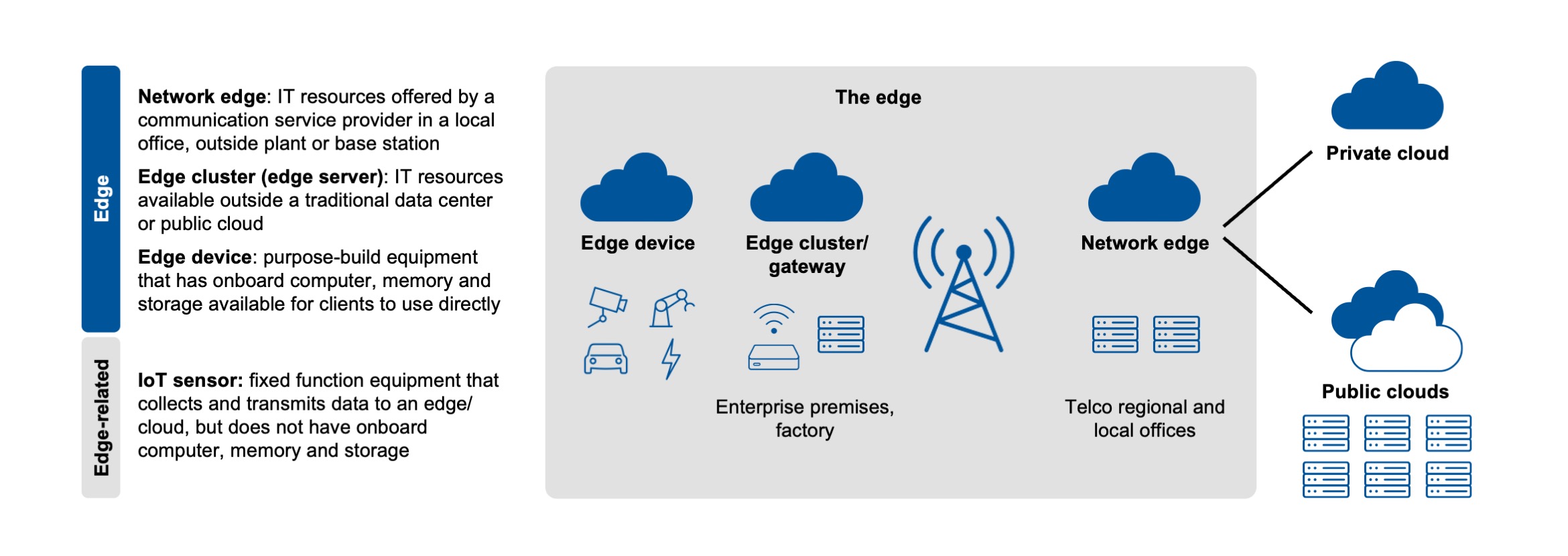
Edge devices have onboard processing, memory and storage. Examples include streaming video cameras, industrial robots, vehicles and drones. Edge devices have a direct interface and interact with real-time data sources (such as IoT sensors) and feature control elements that can alter the state of the device (such as closing a hydraulic valve in a chemical plant by controlling the valve’s servo motor). Edge devices typically experience latency between data source generation and data delivery to application workloads of no longer than 1 millisecond.
An on-premises edge cluster, (also “edge server,” or “on-premises MEC”), such as an industrial computer, may interact with multiple edge devices. The edge cluster typically supports more intense workloads that require higher performance CPUs, GPUs and higher-ordered algorithms based on machine learning inferences. On-premises edge clusters typically experience latency between data source generation and data delivery within 10 milliseconds.
A“telco’s 5G edge” (also“network edge”) is tightly integrated within an MNO’s 5G Radio Access Network (RAN) and is managed like a cloud service. The telco’s edge is either on-premises (such as AWS Outposts) or off-premises (such as AWS Wavelength) and is always managed by a MNO’s cloud partner. As noted earlier, the telco’s edge is a private or public resource, with security solutions to prevent common attacks by providing encrypted and signed messages, prevention of container tampering and support for container update verification. The telco’s edge typically experiences latency (between generation of data at the source and delivery to applications) within 50 milliseconds.1
A good example to explore the relationships between edge node platforms is the autonomous mobile robots (AMRs) used in a warehouse application for a material movement (often referred to as “pick and place”):
1. Edge devices: closest to the point of data generation
Today, AMRs often have a high degree of computational capability integrated within their platform. An autonomous, wheeled robot with an on-board, high-performance processing unit can be integrated with on-board sensors, including Inertial Measurement Units (IMU), GPS receivers, video cameras, and laser-based Light Detection and Ranging (LiDAR) systems for sensor input - in addition to servo motor controllers to manage motion.
In this example, the edge device (the AMR/NVIDIA® Jetson unit) is as close to data collection sensors and operational control components as possible (either via a physical backplane or a dedicated local area Ethernet network). A workload at this location can efficiently receive data from a sensor (such as LiDAR) and determine an obstruction in the path of the AMR to avoid collisions with an appropriate servo-motor controller message.
Consider that the volume of data generated from a single 3-dimensional LiDAR on an AMR may be high: one hour of point cloud data from a typical 3D LiDAR can mean over 100 gigabytes of data. Collecting, processing and reacting to device data within a co-located edge device minimizes latency and avoids network traffic.
The edge device may still provide summary or evaluated data sets to other network-connected computer platforms.
2. On-premises edge clusters
Not all devices generating data are integrated with high-performance, on-board computer platforms. Additionally, workloads that process data from multiple devices may be best suited to higher-capacity, on-premises edge clusters.
For example, if there are multiple AMRs in a facility, the combined LiDAR point clouds and camera video feeds of each AMR may be used to build a single map of a facility, locating each AMR and tracking their real time velocity and direction.
An on-premises edge device may consume the high bandwidth LiDAR point-cloud data from multiple AMRs simultaneously if the AMRs and devices communicate within an on-premises 5G network. Today’s private 5G Sub-6 data networks provide an experience similar to direct-edge devices for on-premises edge clusters. For edge device and edge clusters that are not “5G enabled” by their vendors (that is, they do not have integrated 5G modems), devices such as 5 Gigabit Ethernet and 5G gateways can provide convenient network access.
The workload on the AMR’s direct edge device is well-suited to an algorithm that can affect motion based on sensor data (i.e., “emergency stop” in case of an immediate collision threat). The workload on the on-premises edge device is well suited to an algorithm that can provide supervisory analysis of all AMRs and provide a sophisticated dispatch and navigation control to avoid collisions and provide least-cost routing.
3. “The telco’s edge”
The network edge, or the “The telco’s edge” is an alternative to the on-premises edge device.
Direct and on-premises edge devices provide great benefits for low-latency and high-volume bandwidth workloads based primarily on their distance to data sources. Each requires a degree of network and system administration and a financial investment to scale upwards as workloads may increase. It is commonly the customer’s responsibility to install, configure, manage and maintain on-premises edge device platforms. This includes managing any required security controls to avoid rogue access of critical data, or command and control of the devices.
Conversely, the network edge is managed by a hyperscaler in partnership with the MNO. Hyperscalers are cloud platform providers such as Amazon Web Services and Google Cloud Services. They have partnered with MNOs to provide local zones that are tightly integrated within the MNO’s radio access network (RAN) via a direct-carrier gateway. Many of the products and services (such as compute, storage, database, analytics, machine learning and security) provided by the hyperscaler are made available on the network edge and are network-integrated closely within the mobile network operator’s 5G RAN. This offering promotes continued low latency and high bandwidth between both 5G-enabled devices on-premises and application workloads that are hosted on a hyperscaler’s local zone.
This approach is readily scalable, since the hyperscaler’s products and services are inherently adjustable by product selection and subscription, rather than by the purchase, replacement, addition and/or installation of on-premises edge hardware devices. By applying a hyperscaler’s local zone edge, administration and maintenance of the edge device’s platform is now the responsibility of the hyperscaler (at the cost of subscription and usage fees).
Edge application management
An advantage of an edge computing environment is that workloads may be containerized and managed by edge application managers to distribute workloads among the most appropriate platforms for execution. Effective edge application management can determine in real time if the resources available on target edge devices meet the requirements of the workload. By re-distributing the workloads if outages or disconnects occur, they can then manage the workload’s installation, execution and dynamic migration (based on scalability requirements or to assure continuous operation).
Balancing workloads among edge platforms
Properly-designed and containerized workloads are portable across edge devices, clusters and telco’s edge platforms. This promotes flexibility during initial trials and deployment. If any of the application requirements change, then edge clusters and/or telco’s edge platforms may be added or enhanced, and the solution workloads may be re-distributed.
For example, a workload may require latency with source datasets at a 5-millisecond rate. In this case, the workload may be applied to an edge cluster platform. Conversely, a workload may require a CPU/GPU performance profile that exceeds the capability of edge cluster platforms. When a 50-millisecond latency is sufficient, this workload may be applied to the telco’s edge platform.
The benefit of applying a telco’s edge platform early is that applications may be developed in a fast-paced, agile way by adhering to cloud-native containerized techniques. With testing and characterization studies, an evaluation can be made as to whether the realized bandwidth and latency observations meet the requirements of the use case - without the capital expense of purchasing and integrating edge cluster platforms. If selected workloads need to be closer to the source of the data (for latency or for data security), then workload migration can be facilitated by edge management platforms.
Benefits of the telco’s edge
The telco’s (network’s) edge is a fundamental component of a 5G edge solution, providing these benefits:
- The telco’s edge may host containerized workloads that have been created for on-premises edge servers or edge devices, to provide superior compute resources on a subscription basis (with outsourced system and network management) while retaining much of the bandwidth and latency characteristics of on-premises edge servers.
- Telco’s edge services are highly integrated with the hyperscaler’s cloud computing architecture, enabling higher-order cloud computing products and scalability.
- A telco’s edge provides inherent cloud security models (via integrated prevention, detection, response and remediation) that are supported by the hyperscaler’s cloud computing platform.
- Telco’s edge workloads are scalable and distributable by subscribing to additional or enhanced compute, storage, database or AI products.
- Telco’s edge services are managed by the MNO and their cloud computing partner. Configuration and monitoring are available to the enterprise deploying the application workloads, without the need for system, network or security management teams.
- The telco’s edge appears as an extension to core cloud computing platforms. Without further training or skills, a developer certified in cloud computing skills may immediately create and manage application workloads to be hosted on the telco’s edge.
Next steps
Integrating a telco’s cloud into a 5G edge deployment allows developers and enterprises to take advantage of a telco’s mobile network expertise and end-to-end security capabilities, as well as the strong relationships telcos have with hyperscalers. You can continue to explore these possibilities by exploring A developer’s guide to 5G.
1.“Who cares about latency in 5G?” Reiner Ludwig, Ericsson Aug 16 2022


 Back to top